
How to Establish and Maintain Successful, Scalable Supplier Relationships
By Yan Luo | Samtop Display
Building a long-term display supplier partnership is key to executing global display campaigns with consistency, speed, and cost control. Success depends on aligning goals, defining expectations, maintaining open communication, and working with experienced partners who can scale and adapt with your needs.
At Samtop, we support global brands by building long-term partnerships rooted in quality, reliability, and shared sustainability values.
Managing multiple suppliers for your global retail displays is time-consuming, inconsistent, and risky. From production delays to branding inconsistencies, the wrong partner can derail your entire campaign.
A single misstep—a misprinted color, late delivery, or subpar finish—can damage your brand image in high-visibility markets. And switching suppliers mid-campaign? Even more costly.
A long-term partnership with a reliable display supplier solves these issues. With aligned values, scalable production, and transparent processes, your brand can deliver consistent, high-quality displays globally—with less stress and more impact.
📊 Why Long-Term Display Supplier Partnerships Matter
| Benefit | Impact on Global Campaigns |
|---|---|
| Consistency | Ensures branding, finishes, and messaging remain uniform across markets |
| Cost Efficiency | Volume-based discounts, reduced rework costs, and predictable pricing |
| Faster Lead Times | Suppliers understand your expectations and work faster with less guidance |
| Sustainability Alignment | Suppliers can integrate eco-friendly practices over time |
| Innovation and Scalability | Long-term partners evolve with your brand and adopt new technologies |
🔧Best Practices for Building a Long-Term Display Supplier Partnership
1. Clearly Define Expectations Early
- 📝 Establish design guidelines, color standards, and tolerance specs
- 📦 Define packaging, shipping, and labeling rules for multi-country delivery
- 📆 Set lead time expectations and performance benchmarks in a written SLA
Tip: Use a global style guide to align every display element across regions.
2. Foster Transparent and Continuous Communication
- 🔁 Schedule weekly check-ins (Zoom, WeChat, Teams) during key production phases
- 🛠 Use shared dashboards (Asana, Trello) for live updates
- 📩 Assign dedicated project managers on both sides to avoid confusion
Tip: A single point of contact avoids the "lost in translation" effect between teams.
3. Invest in Quality Control and Inspection
- 📍 Conduct on-site visits (or third-party audits) to verify capabilities
- 📸 Request photos and videos during pre-production and mass runs
- 📊 Create a QC checklist: visual finish, structural integrity, color match, packaging
Tip: Use pre-production samples (PPS) and require approval before full rollout.
4. Align Sustainability and Innovation Goals
- 🌱 Ask if suppliers offer recycled materials, water-based inks, or modular designs
- 🧪 Encourage innovation: 3D printing, AR integration, digital signage compatibility
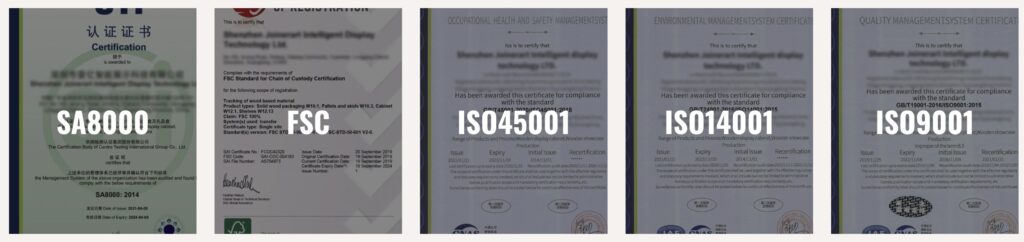
- 📄 Request certificates: FSC, RoHS, ISO 14001, etc.
Tip: Long-term partners can help you co-develop green solutions with lower carbon footprints.