

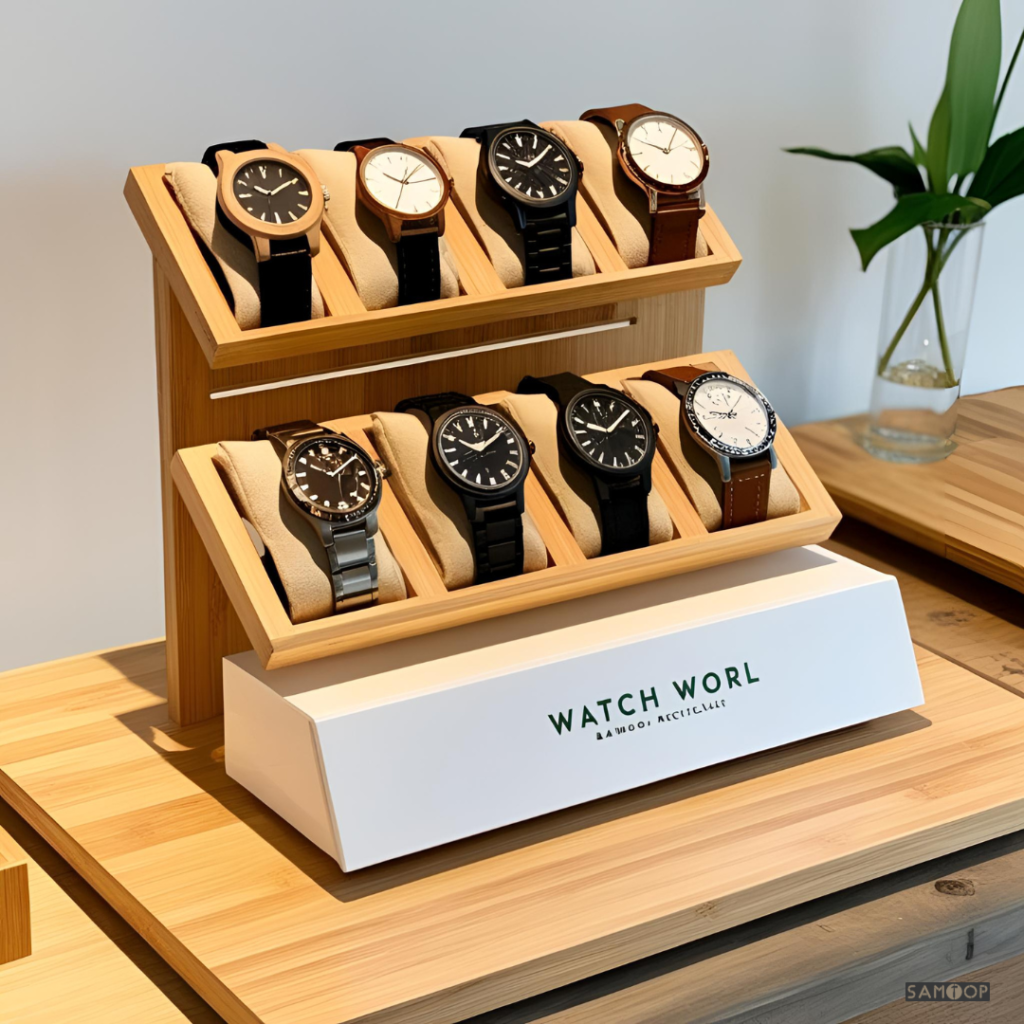
The travel retail industry is entering a green era. In duty-free zones, premium watch brands can no longer rely on visuals alone — today, eco-conscious values define modern luxury.
Creating sustainable watch display fixtures that align with brand image, meet airport regulations, and reduce logistics cost has become a new standard in global retail.
If you're looking for a solution that balances eco materials, modular systems, flat-pack logistics, and brand consistency, this article is your go-to guide.
[Claim]: Sustainable watch displays help reduce carbon footprint, optimize branding, and lower long-term costs.
1. What Does “Sustainability” Mean in Duty-Free Zones?
In global airports and travel retail, sustainability isn’t just a concept — it involves strict standards and tangible execution.
Sustainable watch displays must use eco-certified materials (like recycled acrylic or FSC wood), minimize shipping volume, support tool-free assembly, and comply with international fire-safety regulations.
Gen Z and millennial luxury travelers value environmental responsibility, making eco-conscious POS design a competitive advantage.
| Consideration | Why It Matters in Duty-Free Zones |
|---|---|
| Material recyclability | Required by airport green certifications like FSC, REACH |
| Packaging volume & weight | Flat-pack shipping lowers emissions and freight costs |
| Assembly & reusability | Essential for seasonal resets, pop-ups, and quick setups |
| Fire compliance | Mandatory for airport and mall installations |
| Brand image alignment | “Green luxury” resonates with new-generation premium buyers |
📌 Summary: A sustainable watch display must be lighter, smarter, and globally compliant.
2. What Materials Are Best for Eco-Friendly Watch Displays?
Choosing sustainable materials requires balancing aesthetic appeal, functionality, and regulatory compliance across regions.
Materials like recycled acrylic, FSC-certified MDF, and RPET textiles are ideal for building sustainable watch displays — offering both elegance and structural integrity.
Layering different textures, such as bamboo veneers and frosted acrylic, helps blend eco values with modern luxury.
| Material | Eco-Friendly Feature | Applications |
|---|---|---|
| FSC-certified MDF | Legally harvested wood fiber | Display base, risers |
| Recycled acrylic (PMMA) | 80–90% clarity of virgin acrylic | Transparent trays, lightboxes |
| Water-based PU coating | Low VOC, non-toxic surface treatment | Soft-touch finish for trays, stands |
| Bamboo veneer | Fast-growing, biodegradable material | Decorative panels and wraps |
| RPET felt / fabrics | Made from recycled plastic bottles | Drawer linings, texture panels |
| Modular steel structures | Recyclable, durable, and easy to disassemble | Flat-pack display frames |
✅ SEO note: These materials apply to sustainable display solutions, eco-friendly POS, and flat-pack watch displays.
3. Why Are Modular Flat-Pack Displays Ideal for Global Rollouts?
Traditional display units are bulky, costly to ship, and often difficult to install — especially in airport or customs environments.
Modular and flat-pack display systems simplify global rollouts and reduce environmental impact — making them a preferred choice in travel retail.
These sustainable display solutions allow you to deploy unified systems globally while localizing elements like signage.
| Strategy | Sustainability Benefit + Use Case |
|---|---|
| Flat-pack engineering | Reduces volume by 60% (e.g., 1m³ → 0.4m³), lowers freight costs and emissions |
| Snap-fit or magnetic joinery | Tool-free, fast assembly, easy to disassemble and reuse |
| Replaceable panels | Maintain the base, switch out the graphics for each campaign |
| Shared regional SKUs | Lower waste, maintain consistent branding |
| Foam-free packaging | Use molded paperboard or corrugated fiberboard — zero-waste ready |
📌 Keywords embedded: modular watch display, eco-friendly POS, green packaging for retail fixtures