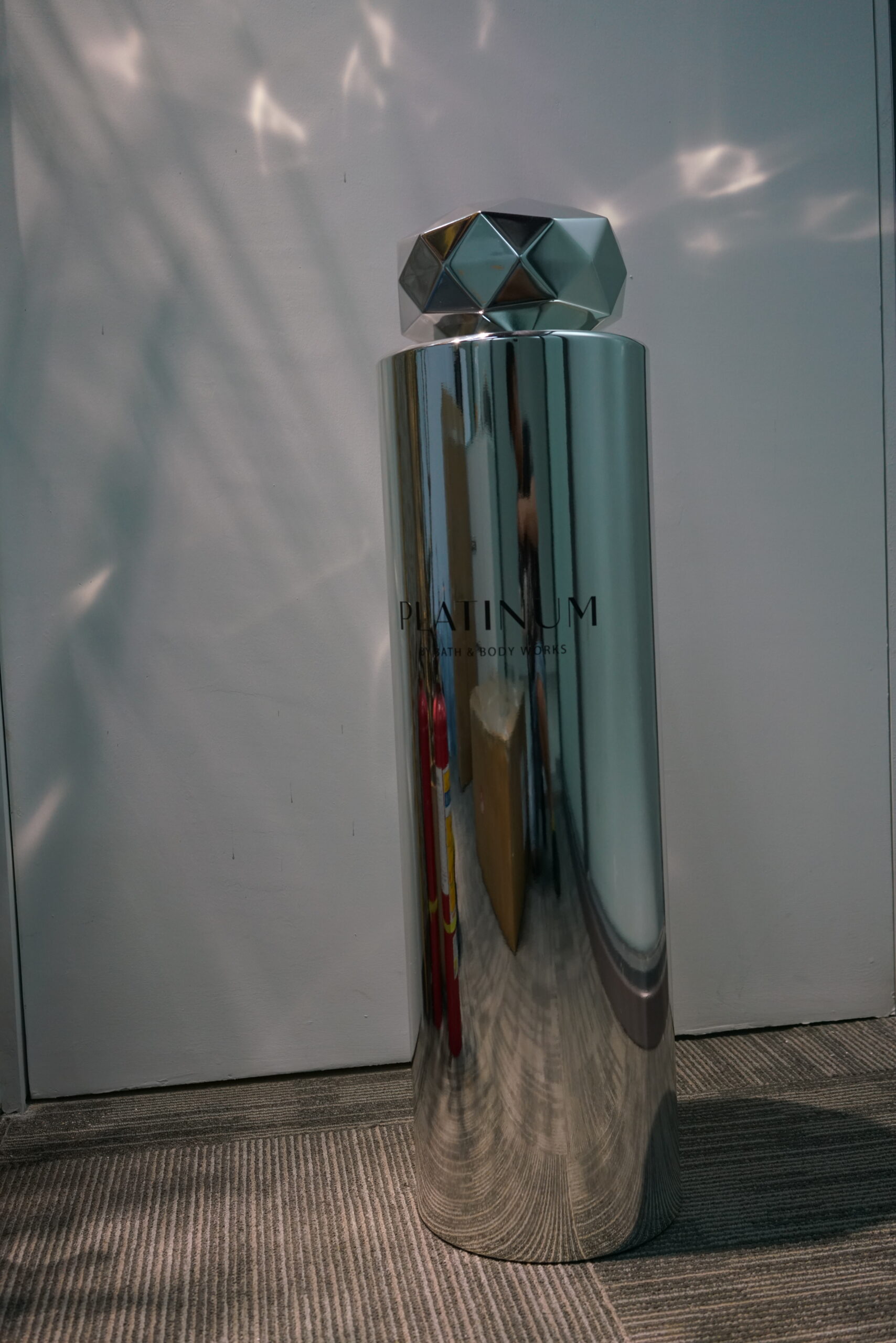
Custom prop fabrication often becomes more challenging when a visually simple design is enlarged. This oversized perfume bottle is a good example: one cylindrical body, one geometric cap, and a metallic mirror finish created three very different manufacturing challenges.
The body had to stay smooth across a much larger surface, the faceted cap required accurate angles and symmetry, and the mirror finish exposed imperfections that would have been far less noticeable on a matte surface. Packaging added another consideration, as the finished prop needed to be protected without creating unnecessary shipping volume.
Solving these issues required more than fabrication alone. Engineering, prototyping, surface preparation, assembly, and packaging had to be considered as one connected process.
In this case study, we break down how this oversized perfume bottle display moved from prototype to final delivery—and the decisions that helped control shape, finish quality, and shipping risk.
What Is Custom Prop Fabrication?
Custom prop fabrication is the process of turning a creative concept, 3D model, drawing, or reference product into a physical display through engineering, prototyping, material selection, fabrication, finishing, assembly, quality control, packaging, and delivery. For oversized or complex retail props, the process must also account for structure, surface quality, weight, transportation, and installation.
Typical applications include custom display props, oversized retail props, window display props, giant product replicas, branded props, pop-up installations, and visual merchandising displays.
From Technical Drawing to Finished Display
This project involved recreating a perfume bottle as an oversized branded display. Although the form appears simple—a cylindrical body with a decorative faceted cap—the two components required different manufacturing approaches.
| Project |
Requirement / Approach |
| Display type |
Oversized fragrance bottle display / product replica |
| Production quantity |
1,920 pcs |
| Reference scale |
Approx. 1.2 m overall height |
| Main body |
Round tube cylindrical construction |
| Decorative feature |
Multi-faceted geometric cap |
| Finish |
Electroplated high-reflection metallic finish |
| Construction |
Separate body and cap |
| Main challenges |
Surface consistency, geometry, finishing, batch consistency and shipping |
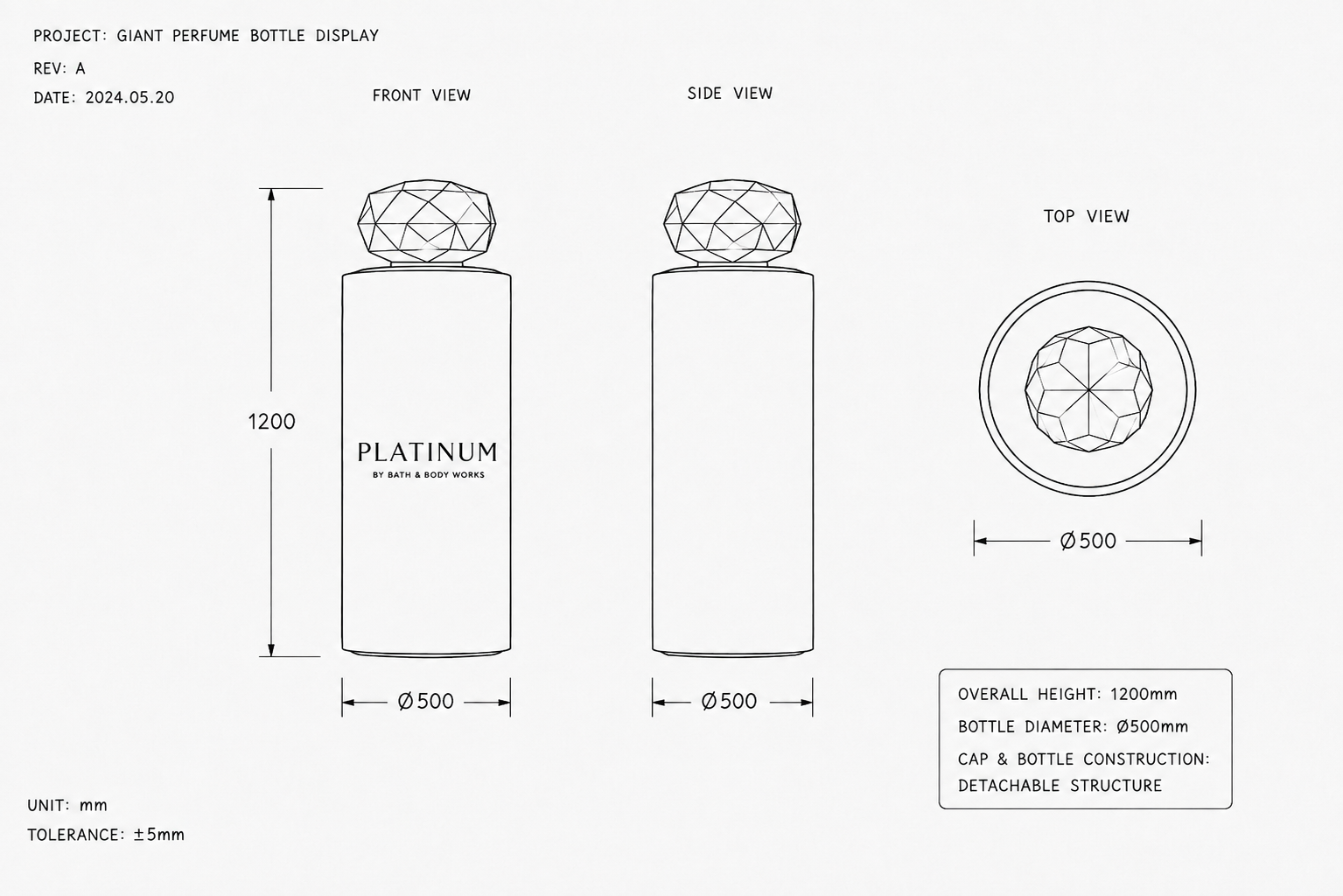
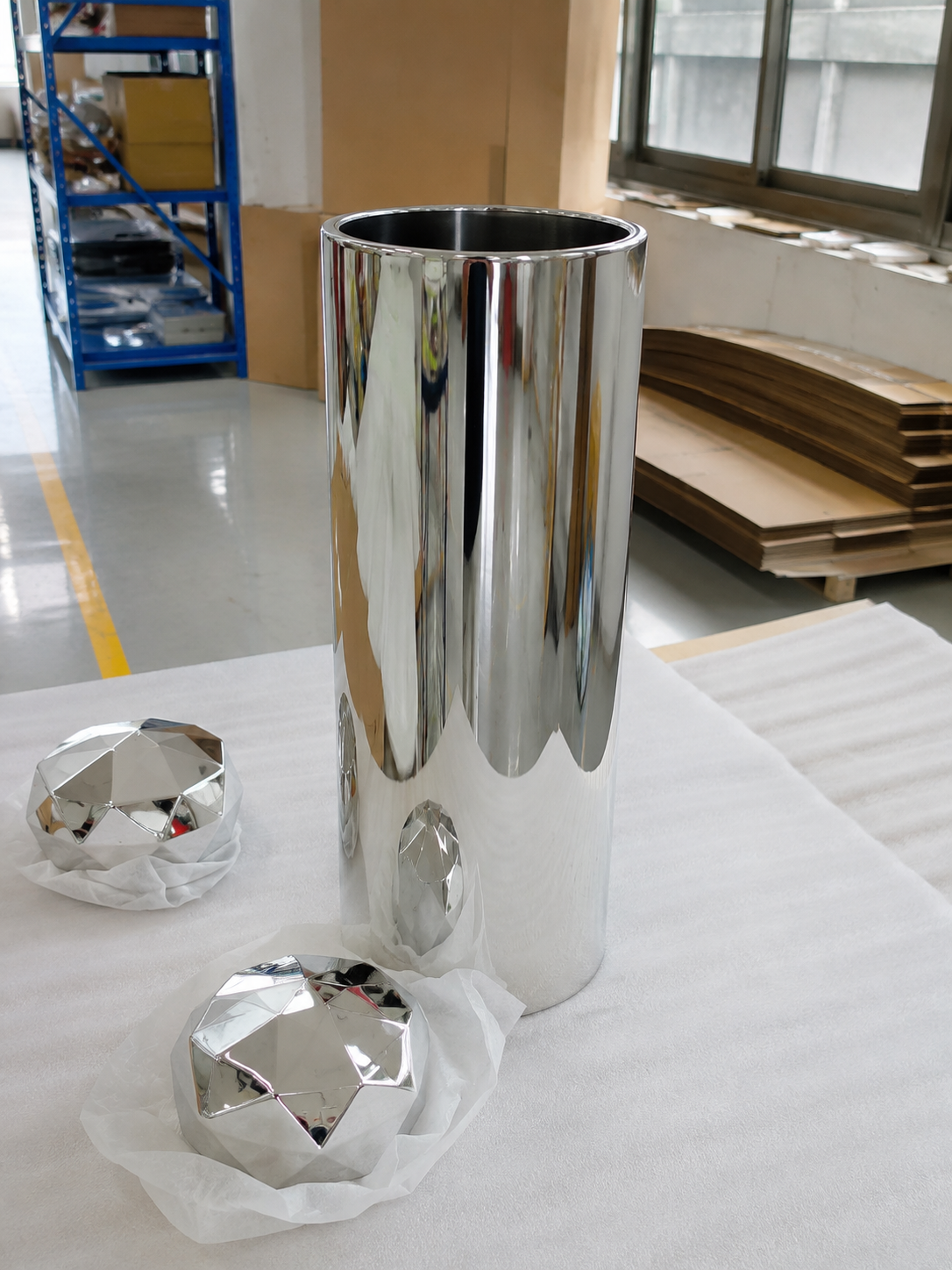
The engineering drawing defined the 1.2 m scale, Ø500 mm cylindrical body, faceted cap geometry, and detachable construction. The finished display shows how these engineering decisions translated into a mirror-finish oversized retail prop while preserving the intended proportions and visual character.
Dimensions shown in the project illustration are approximate and are used to communicate scale rather than final production specifications.
From Creative Design to Production Engineering
A design agency or visual merchandising team may provide a rendering, 3D model, dimensions, finish references, and brand guidelines. These explain what the display should look like, but they do not necessarily explain how it should be manufactured.
For oversized fragrance bottle display production, the engineering challenge is not simply enlarging the original product. The design must be translated into a structure and manufacturing process that can be reproduced consistently at the required quantity and budget.
The first task is therefore feasibility review.
An object shown as one complete piece in a rendering does not always need to be manufactured that way. Structure, weight, surface finish, assembly, packaging, and installation can all influence how the prop should be divided.
For this perfume display, the geometric cap and cylindrical body were treated as separate components. The body required a smooth continuous surface, while the cap depended on accurate facets, edges, and intersecting planes.
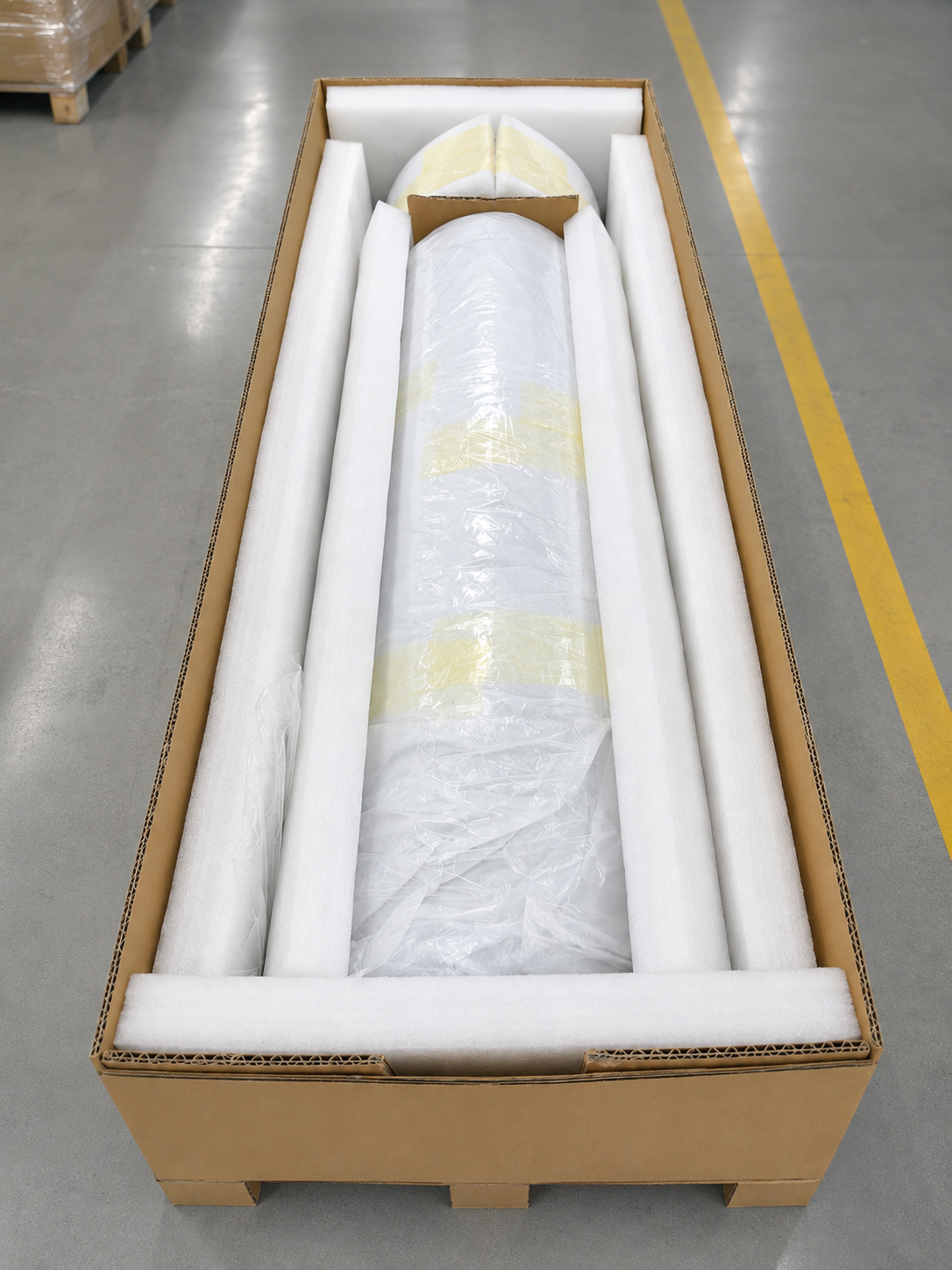
Separating them made both manufacturing problems easier to control. It also created an advantage later: the finished components could be protected and packed separately for transportation.
This is why engineering and logistics should be considered together rather than as separate stages.
Packaging should therefore be considered as part of the product-development process, particularly when oversized or high-finish components are shipped internationally.
Why Prototype Development Matters for Oversized Display Props
A prototype is more than something for the client to approve visually. In custom prop fabrication, it is an engineering checkpoint.
It can help verify proportion, silhouette, geometry, connection details, stability, and surface shape before the final finishing process begins.
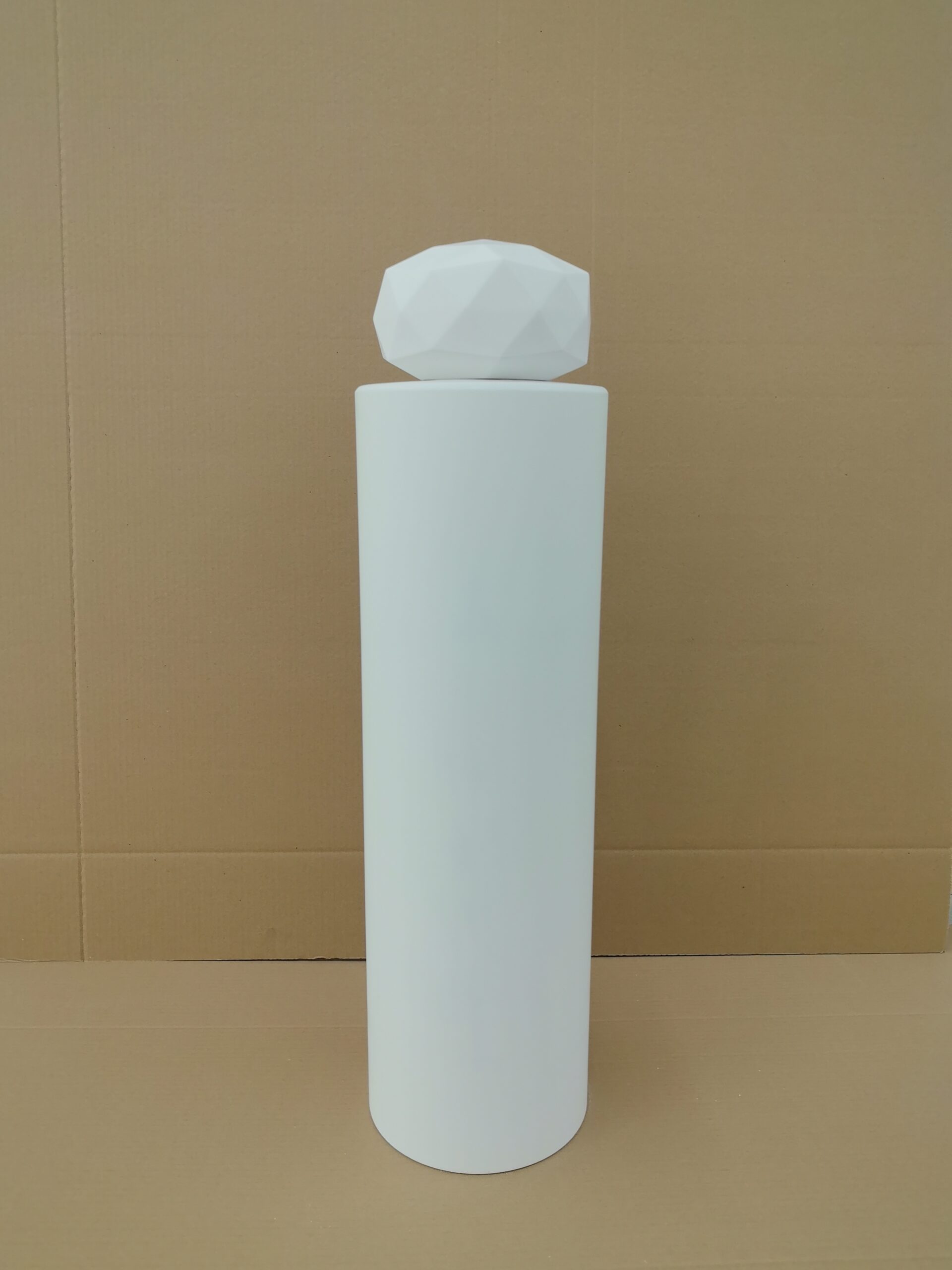
A perfume bottle that looks balanced at normal product size cannot always be enlarged by simply multiplying every dimension. Viewing distance changes, curves become more obvious, edges appear heavier, and decorative elements may dominate the overall silhouette.
A cap that looks well proportioned on a handheld product, for example, may feel too large or too small when transformed into an oversized retail display.
Prototyping therefore reduces risk. Correcting geometry or proportion at this stage is usually easier than discovering the problem after fabrication and final finishing are complete.
Fabricating Large Smooth Surfaces
The bottle body appears simple because it is essentially a large cylinder. In production, however, large smooth surfaces can be surprisingly unforgiving.
For this 1,920-piece production run, the cylindrical bottle body was based on a round-tube structure rather than building the same geometry through a more complex custom-forming process. Because the main body was already cylindrical, this approach simplified fabrication and helped control the production budget while maintaining the required overall shape.
Common issues include inconsistent curvature, local waves, visible seams, uneven edges, sanding marks, and imperfect transitions.
These problems become much more noticeable when the final surface is reflective. A matte finish may visually soften a small imperfection, while a mirror-like surface reflects lights, walls, straight lines, and nearby objects. Even a slight wave in the substrate can distort those reflections.
This leads to an important rule:
A mirror finish cannot hide poor surface preparation—it makes it more visible.
For premium custom display props, the substrate must already be smooth and controlled before the final metallic finish is applied.
Controlling the Faceted Geometry of the Perfume Cap
The cap created a different challenge.
Unlike the smooth cylindrical body, it contained multiple facets, edges, and intersecting planes. A small error in one surface could affect the appearance of several neighboring surfaces.
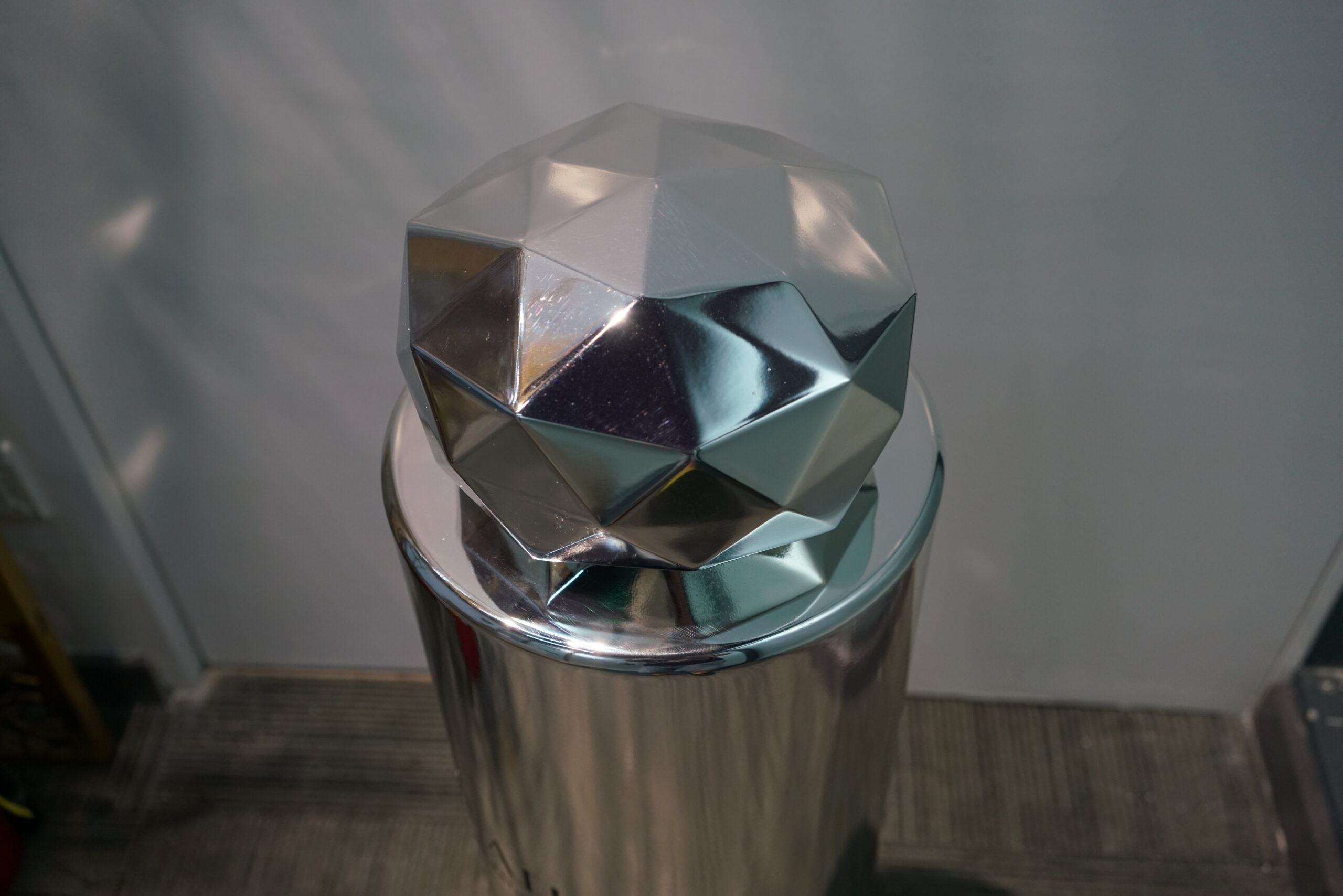
An incorrect angle changes adjacent faces. An uneven plane changes the reflection. An inaccurate edge can make the complete cap appear asymmetrical.
These differences become even more visible after a reflective finish is applied.
Complex custom retail props may therefore require repeated shape correction, sanding, fitting, and inspection before final finishing. Depending on the design, different components may also require different materials or manufacturing processes.
The objective is not to force the entire prop into one production method. It is to choose the most practical combination for the required shape, finish, strength, weight, quantity, and transportation conditions.
Why Surface Preparation Determines Mirror-Finish Quality
Mirror finishes reveal what is underneath.
Pinholes, scratches, sanding marks, visible joints, dust, uneven edges, and local surface waves can all become more noticeable once the prop starts reflecting its surroundings.
| Matte Finish |
Mirror Finish |
| Can soften minor defects visually |
Magnifies surface defects |
| Lower reflection |
High reflection |
| More forgiving substrate |
Surface preparation is critical |
| Small waves may be less noticeable |
Reflections reveal waves |
For this reason, QC should not happen only after the prop is finished.
Intermediate inspection before the final surface treatment is especially important for reflective props. If a defect is discovered after finishing, correction may require removing or reworking the finished surface, adding time and cost.
For this project, the reflective metallic appearance was achieved through electroplating. With 1,920 units in production, the challenge was not only achieving a high-reflection finish on one bottle, but maintaining consistent surface appearance across the full batch. Surface preparation therefore had to be controlled before plating, as scratches, unevenness, or local defects could become more visible after the reflective finish was applied.
A surface that looks acceptable under workshop lighting may behave differently under directional retail lighting. Distortion or surface waves can become more obvious once the display is installed in a store or window.
Branding, Assembly and Final Quality Control
Once the body and cap are finished, they still need to be evaluated as one branded display.
Logo size and positioning become more sensitive on an oversized product replica because the viewing distance differs from the original product. A logo can be technically centered according to a drawing but still look visually wrong on the finished prop.
For this reason, QC is useful at two levels.
Component inspection checks geometry, edges, joints, surface smoothness, finish quality, and branding before assembly.
Final assembly inspection checks the cap-to-body fit, alignment, stability, overall proportion, logo position, and appearance from normal viewing angles.
A component can look acceptable on its own but still create a problem after assembly. The client is not buying individual parts; they are buying one finished visual display.
Designing Oversized Props for Packaging and International Shipping
The decision to manufacture the cap and body separately was not only about fabrication. It also affected packaging.
Oversized props commonly create two logistics problems: damage risk and shipping volume.
Irregular or projecting components can be vulnerable during handling, while highly reflective surfaces need protection from rubbing, scratches, and pressure. Different components may therefore require different protective packaging.
Volume is another issue. International freight can be influenced by the amount of space occupied by the packed product. A permanently assembled oversized prop may create a large package containing significant unused space—in practical terms, you may end up paying to ship air.
| One-Piece Construction |
Modular Construction |
| Simpler final setup |
Requires planned connections |
| Often larger packing volume |
Can improve packing efficiency |
| Fragile details remain exposed |
Fragile parts can be protected separately |
| Harder to handle when oversized |
Smaller sections are easier to handle |
| Damage may affect the entire prop |
Individual parts may be replaceable |
Modular construction is not automatically better for every project. The right decision depends on geometry, structure, finish, installation method, destination, and size.
The important point is to make that decision during engineering rather than after production.
Choosing Materials for Custom Display Prop Fabrication
There is no single best material for a custom prop.
Material selection should follow the design and engineering requirements. A large sculptural form, transparent detail, internal structure, and decorative component may all require different solutions.
Depending on the project, fabrication can involve fiberglass, resin, foam, acrylic, metal, wood, 3D-printed components, or mixed-material construction.
For example, a lightweight sculptural shell may require a different material from an internal reinforcement structure. A transparent feature may favor acrylic, while complex prototype geometry may be easier to verify using foam or 3D-printed components.
The better question is therefore not simply “Which material is cheapest?” but:
Which material and process combination can achieve the required shape, finish, strength, weight, quantity, packing method, and installation requirement with the lowest practical risk?
Key Takeaway from This Custom Prop Fabrication Project
This project shows why oversized prop fabrication should be planned as one connected process rather than a series of isolated production steps. The perfume bottle looked visually simple, but its scale, faceted cap, reflective surface, branding, and shipping requirements influenced decisions from prototyping through final assembly.
At a production quantity of 1,920 units, the challenge was not simply making one prototype look right, but reproducing the same geometry and reflective finish consistently across the batch. Using a round-tube structure for the cylindrical body helped simplify fabrication and control the production budget, while electroplating delivered the required metallic appearance. Separating the cap from the body also made geometry control, finishing, packaging, and transportation more manageable.
FAQ About Custom Prop Fabrication
What is custom prop fabrication?
Custom prop fabrication turns a creative concept, drawing, rendering, or reference object into a physical display through engineering, prototyping, fabrication, finishing, assembly, QC, packaging, and delivery.
How are oversized display props manufactured?
The process normally includes design review, engineering, prototyping, fabrication, surface preparation, finishing, assembly, QC, and packaging. Complex props may combine several materials and manufacturing methods.
Why is prototyping important for oversized props?
Prototyping helps verify proportion, geometry, stability, connection details, and surface shape before final production, reducing the risk of expensive corrections later.
What materials are used for custom display props?
Common options include fiberglass, resin, foam, acrylic, metal, wood, and composite materials. Selection depends on geometry, finish, strength, weight, quantity, budget, shipping, and installation requirements.
Can oversized display props be manufactured in separate sections?
For international projects, transport packaging testing can also help evaluate how the packaged product performs under distribution hazards. The connection method should be engineered before production begins.
What information should I provide to a display prop manufacturer?
Provide available drawings or renderings, approximate dimensions, quantity, finish references, branding files, expected completion date, installation requirements, and delivery destination. These details allow the manufacturer to review feasibility and recommend a suitable production approach.
Have a Custom Prop Design to Produce?
If you already have a rendering, 3D model, reference product, or early-stage concept, the next step is to determine how it can be manufactured without compromising the original design.
At Samtop, we support creative agencies, visual merchandising teams, and brands with engineering, prototyping, mixed-material fabrication, finishing, QC, packaging, and international delivery for custom display props and retail projects.
Working on an oversized perfume bottle or product replica? Explore our Giant Perfume Bottle Display capabilities, or send us your design, approximate size, quantity, finish requirements, and delivery destination for a project review.