Your creative agency has approved the design of a giant […]
Your creative agency has approved the design of a giant perfume bottle display. The rendering looks impressive: a transparent bottle body, a geometric cap, and a premium finish that reflects the brand's identity.
But can the same design be manufactured at the required size, quantity, and budget?
Choosing the wrong retail display materials can lead to visible joints, excessive weight, expensive tooling, or production difficulties. A material that works for one prototype may not be practical for a 100-piece retail rollout.
The solution is to evaluate materials according to appearance, geometry, weight, production quantity, and total project cost—not material price alone.
Before choosing a material, it helps to understand where each option works—and where it can create problems.
What Should You Consider Before Choosing Retail Display Materials?
A common mistake in custom retail display manufacturing is selecting a material before evaluating the complete design.
For visual merchandising agencies, production managers, and sourcing teams, five factors should guide the decision.
1. Visual Effect and Design Accuracy
Does the display need glass-like transparency, smooth curves, sharp geometric edges, or a solid sculptural appearance?
A transparent perfume bottle and an opaque decorative bottle may have similar silhouettes but require different fabrication methods.
For luxury retail displays, the material must reproduce the approved design without introducing distracting seams or unwanted visual changes.
2. Size, Weight, and Handling
Enlarging a perfume bottle changes the manufacturing requirements.
A solid material may reproduce a small cap beautifully but become unnecessarily heavy at a much larger scale.
Before selecting materials, check the overall dimensions, handling requirements, shipping limitations, and installation environment.
3. Production Quantity
A one-off prototype and a multi-store production order may require different approaches.
For a single display, CNC machining or 3D printing may offer flexibility without extensive tooling.
For repeat orders, molding or forming processes may offer better unit economics, provided the geometry and production volume justify the setup cost.
4. Display Environment
A short-term pop-up display may prioritize low weight and easy handling. A permanent retail fixture may require greater durability and resistance to regular contact.
Material selection should reflect the display duration, customer access, expected reuse, and installation conditions.
5. Total Project Cost
The cheapest raw material does not necessarily produce the most economical display.
Tooling, machining, finishing, assembly, protective packaging, and freight all contribute to the final cost.
For example, a heavier component may be affordable to manufacture but expensive to transport across multiple retail locations.
Comparing Retail Display Materials for Giant Perfume Bottles
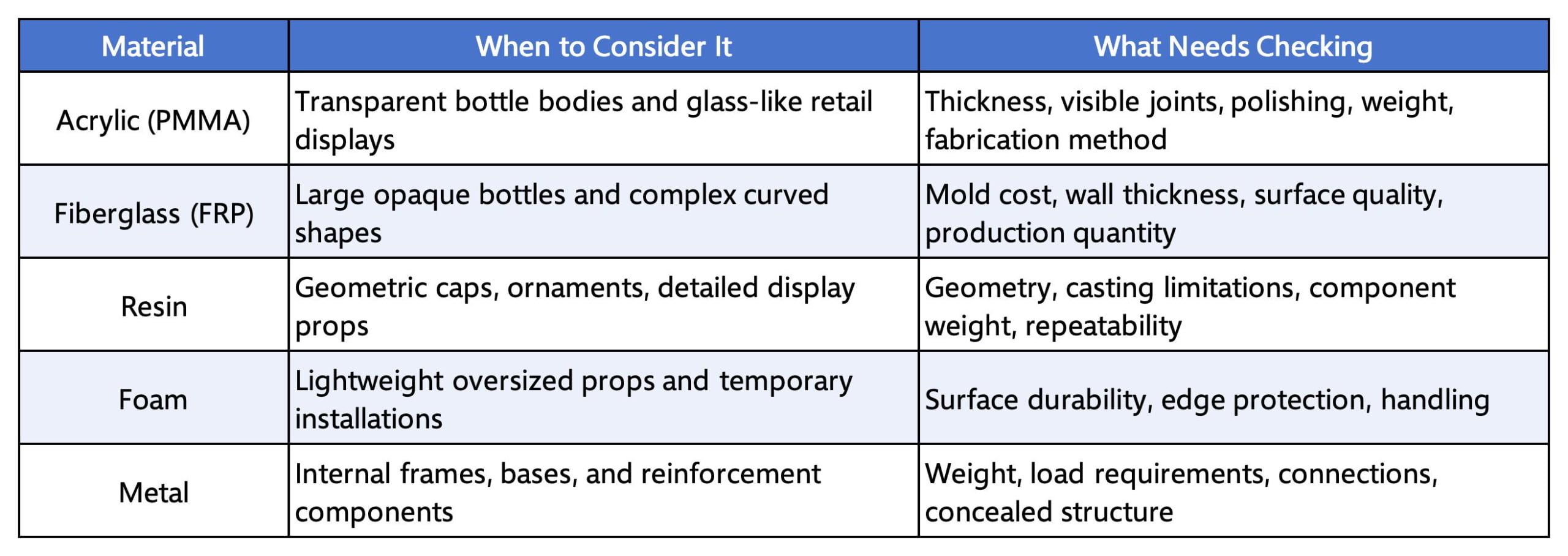
Different parts of an oversized fragrance display often need different materials.
Material
When to Consider It
What Needs Checking
Acrylic (PMMA)
Transparent bottle bodies and glass-like retail displays
Acrylic is a common candidate when a giant perfume bottle needs a clear, glass-like appearance.
However, transparency alone does not determine whether acrylic is suitable.
For large acrylic retail displays, the production team must evaluate material thickness, panel joints, polishing requirements, and how the finished surfaces will look under retail lighting.
A bottle with flat geometric sides may be fabricated differently from one with continuous curved surfaces. Bonded edges can also become more noticeable as the display grows.
When to reconsider acrylic: If the design is fully opaque, extremely large, or requires complex continuous curves, another material may provide a more practical solution.
Fiberglass (FRP): For Large Opaque Display Props
Fiberglass is often considered for oversized retail display props with curved or sculptural forms.
FRP construction can provide large visual volume without requiring a completely solid body.
However, the shape, mold investment, wall thickness, and finishing requirements must be evaluated together.
For a single complex sculpture, tooling may represent a significant part of the budget. For repeated production, the same tooling investment may become more economical across multiple units.
When to reconsider FRP: If optical transparency is essential, conventional opaque fiberglass construction will not achieve the required effect.
Resin: For Detailed Geometric Components
Resin can be useful for decorative caps, sculptural details, and complex shapes that need accurate reproduction.
But not every geometric component should automatically be cast in solid resin.
For a large multi-faceted cap, the manufacturer needs to assess edge definition, casting feasibility, potential weight, and the number of identical pieces required.
A hollow or multi-part construction may be worth evaluating when a solid component would be unnecessarily heavy.
When to reconsider resin: If the component is extremely large or weight-sensitive, alternative fabrication methods may offer a better balance.
Foam and Metal: Lightweight Forms and Hidden Support
Foam is useful for lightweight decorative shapes, especially in temporary displays where handling and installation are important.
Its limitations include surface vulnerability and edge damage, so the intended finish and expected contact should be considered.
Metal serves a different purpose. It is commonly used for support frames, bases, and structural components that are not necessarily visible to shoppers.
The most suitable material combination depends on what each component needs to accomplish.
How Production Methods Affect Material Selection
3D printing and vacuum forming are manufacturing processes, not material categories.
3D printing can be useful for testing complex geometry or producing limited quantities. Vacuum forming may be economical for repeated lightweight shells when suitable tooling and sheet materials can reproduce the required shape.
Visual Merchandising Solutions
Transform your retail space with custom POP displays, window decorations, and luxury merchandising solutions. Get expert consultation and premium manufacturing services.
✓ 20+ Years Experience • ✓ Global Shipping • ✓ Custom Manufacturing
CNC fabrication, casting, and other molding methods offer additional options.
The key question is whether the selected process can reproduce the approved design consistently at the required quantity.
Case Study 1: A Multi-Faceted Perfume Bottle Cap for Large-Scale Production
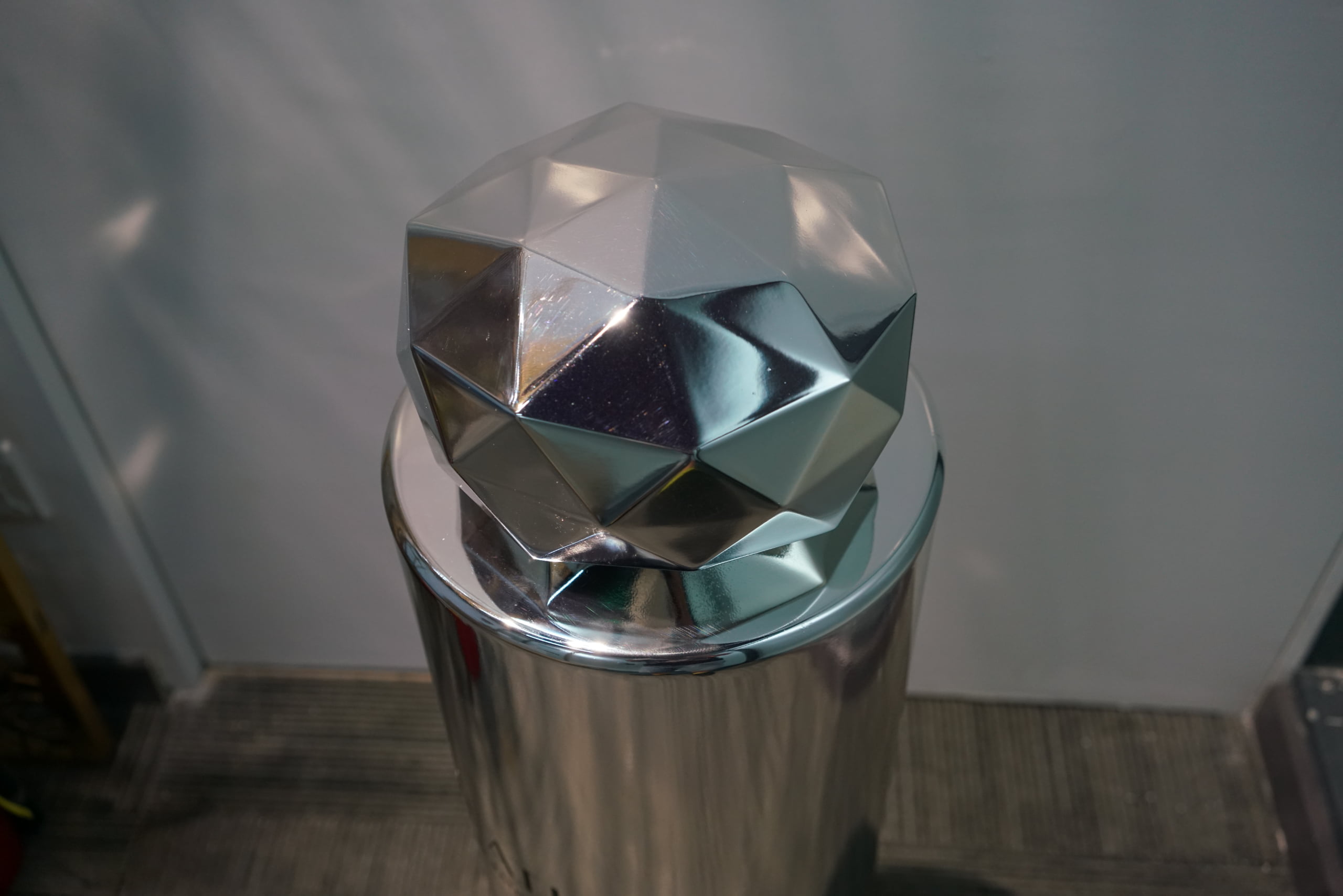
One Samtop oversized perfume bottle project involved a cylindrical body and a complex geometric cap with a high-reflection metallic finish.
According to the published project case study, the display was approximately 1.2 meters tall, with a production quantity of 1,920 pieces.
The cylindrical body and faceted cap presented different fabrication requirements.
For the cap, each geometric plane affected its neighboring surfaces. An inaccurate angle could change the apparent symmetry, while an uneven face could distort reflections after finishing.
This created an important material-selection question: should the entire display be manufactured using one method, or should the cap and body be treated as separate components?
The project adopted separate body and cap construction. The cylindrical body used a round-tube approach suited to its relatively simple geometry, while the cap required greater attention to its faceted shape.
The lesson for sourcing teams is practical: a material or process that suits a smooth bottle body may not be the most efficient choice for a detailed cap.
The project also demonstrates why production quantity matters. A solution must be evaluated for repeatability, not just whether one attractive prototype can be made.
Case Study 2: Material Considerations for a Large Transparent Perfume Bottle
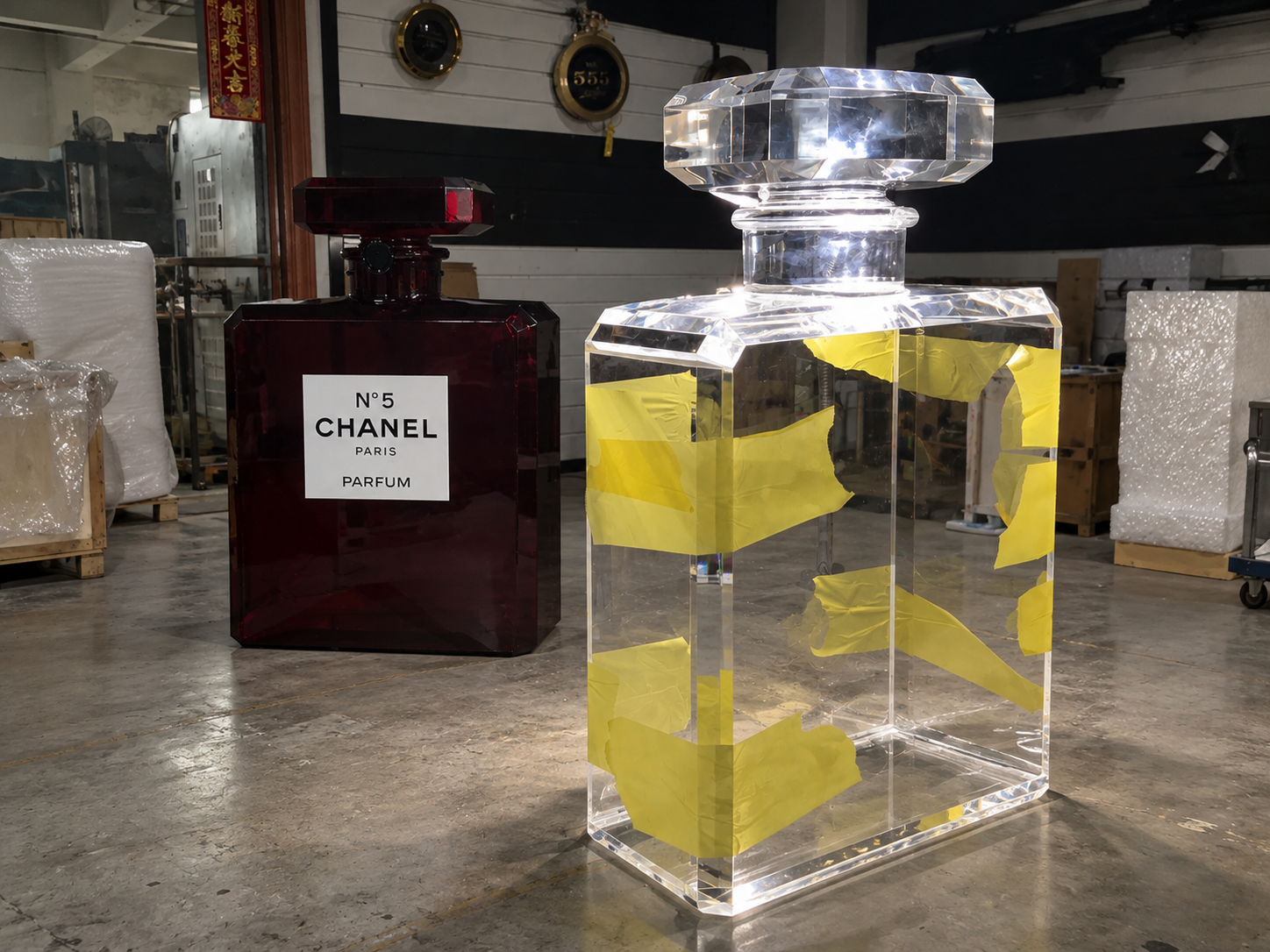
A second Samtop project photograph shows an oversized transparent perfume bottle with thick-looking clear edges and a faceted cap.
Unlike an opaque display, this type of design exposes much more of the construction to the viewer.
For a similar project, acrylic would be a reasonable material candidate because it can provide optical clarity and a glass-like appearance. However, the final material choice should be confirmed against the project's fabrication specifications.
The first consideration is thickness. Thicker transparent sections may create attractive light reflections, but they can also increase material weight and cost.
The second is joint visibility. If a bottle is assembled from multiple panels, the position and quality of the joints can affect the premium appearance.
The third is geometry. Straight edges, beveled corners, and complex curved surfaces may require different cutting, bonding, machining, or forming approaches.
Finally, transparency makes surface quality especially important. Scratches, internal marks, and poorly finished edges may be more noticeable than on an opaque display.
The takeaway: For transparent giant perfume bottle displays, choose the fabrication approach only after evaluating clarity, geometry, joint placement, dimensions, and budget together.
Choosing Materials for Different Retail Display Applications
These are starting points rather than fixed specifications. The final choice should follow the actual design and installation requirements.
What Information Should You Prepare Before Choosing Retail Display Materials?
The more specific the information, the easier it is to compare material options and identify potential manufacturing challenges.
Here are five important details to prepare:
Design drawings or reference images: Share approved renderings, 3D files, or reference photos to communicate the intended shape and visual appearance.
Overall dimensions: Specify the bottle height, width, cap dimensions, and any important geometric details that may affect fabrication.
Visual and material requirements: Clarify whether the display needs transparency, a metallic appearance, sharp geometric edges, or other specific visual effects.
Production quantity: Indicate whether the project involves one prototype, a small batch, or a multi-store retail rollout. Quantity can influence the most practical manufacturing method.
Installation conditions, budget, and timeline: Explain where the display will be used, how long it needs to last, and any budget or delivery constraints.
These details help manufacturers evaluate whether acrylic, fiberglass, resin, foam, metal, or a combination of materials is suitable before committing to production.
FAQ: Retail Display Materials and Giant Perfume Bottle Manufacturing
Can a giant perfume bottle display combine acrylic, resin, and metal components?
Yes. Different components may require different materials. For example, acrylic can be considered for a transparent bottle body, resin for detailed decorative elements, and metal for concealed support.
The final material combination depends on the design, dimensions, weight requirements, and production quantity.
Does a prototype always use the same material and process as mass production?
No. A prototype may use CNC machining, 3D printing, or other flexible fabrication methods to evaluate geometry and appearance.
For larger production quantities, manufacturers may consider molding, vacuum forming, or other repeatable processes to improve efficiency and consistency.
If the production method changes after prototyping, the manufacturer should confirm that the final appearance and dimensions still meet the approved design requirements.
How do production quantities affect material selection for giant perfume bottle displays?
Production quantity can influence tooling investment, fabrication methods, and unit cost.
For a one-off display, a flexible manufacturing process may be more economical than creating dedicated molds. For a larger retail rollout, investing in suitable tooling may improve repeatability and reduce the cost per unit.
The best approach depends on the component geometry, required finish, and total order quantity.
Final Thoughts: Choosing the Right Materials for Your Display
Choosing the right retail display materials is not about finding one material that works for every component.
A transparent bottle body, a geometric cap, and a concealed support structure may each require a different solution. The most practical approach is to evaluate visual appearance, geometry, production quantity, and total project cost together.
At Samtop Display, we help brands and visual merchandising agencies evaluate material options, develop prototypes, and manufacture custom retail display props based on their project requirements.
Planning a custom giant perfume bottle display?
Share your design concept, dimensions, quantity, and finish expectations with our team to discuss suitable material and fabrication options.
Founder and CEO of Samtop Display with over 20 years of experience in luxury visual merchandising and custom manufacturing. Expert in multi-material solutions for premium brands worldwide.